


When was the last time you heard the phrase, “treat others the way you want to be treated”? As simple and almost cliché as this one-liner is, it feels as though it has left the modern framing for how we interact with others.
We don’t smile as often in the hallways of our apartments.
We don’t know our neighbours.
We keep contained within our own walls of convenience.
But that doesn’t mean we want to be treated that way.
How often are we sitting beside strangers when we both crave connection but don’t take the opportunity?
It reminded me of my piece from January 2025, “Why are we experiencing more loneliness?”, where I outlined:
“Maybe the solution is more straightforward: organizing more opportunities to bring people together for casual conversations and connections. But then I started asking an even deeper question: Do people want casual discussions anymore, especially with strangers?
While that idea in isolation may sound odd or uncomfortable, these serendipitous conversations can increase our sense of belonging and community. Discomfort, after all, is something we can avoid in today’s world, but should we? I’d argue no.”
The winter blues brought up similar reflections this January as well. Fewer degrees and a couple extra feet of snow will do that to you. But then, I stumbled upon a video of someone doing trivia on a TTC bus.

For those unfamiliar, the TTC is Toronto’s (somewhat infamous) transit system. It has iconic red streetcars, red fabric-covered seats (seriously, why fabric????), and everyone who’s lived in Toronto long enough has a story about it. But here’s what the TTC isn’t: a place where strangers talk to each other.
The TTC is silent. A crowd of people avoiding eye contact, staring at phones, especially since they added 5G service in 2023. Before phones, it was newspapers. Transit has never been a place to strike up a conversation. It’s point A to point B, nothing in between.
Which is precisely what made @itsmagneticmj’s TTC trivia stop me in my tracks. He was someone actively choosing discomfort, walking up to strangers in one of the least social spaces.
I needed to meet him. I needed to know why and how he was getting up the courage to make these first moves.
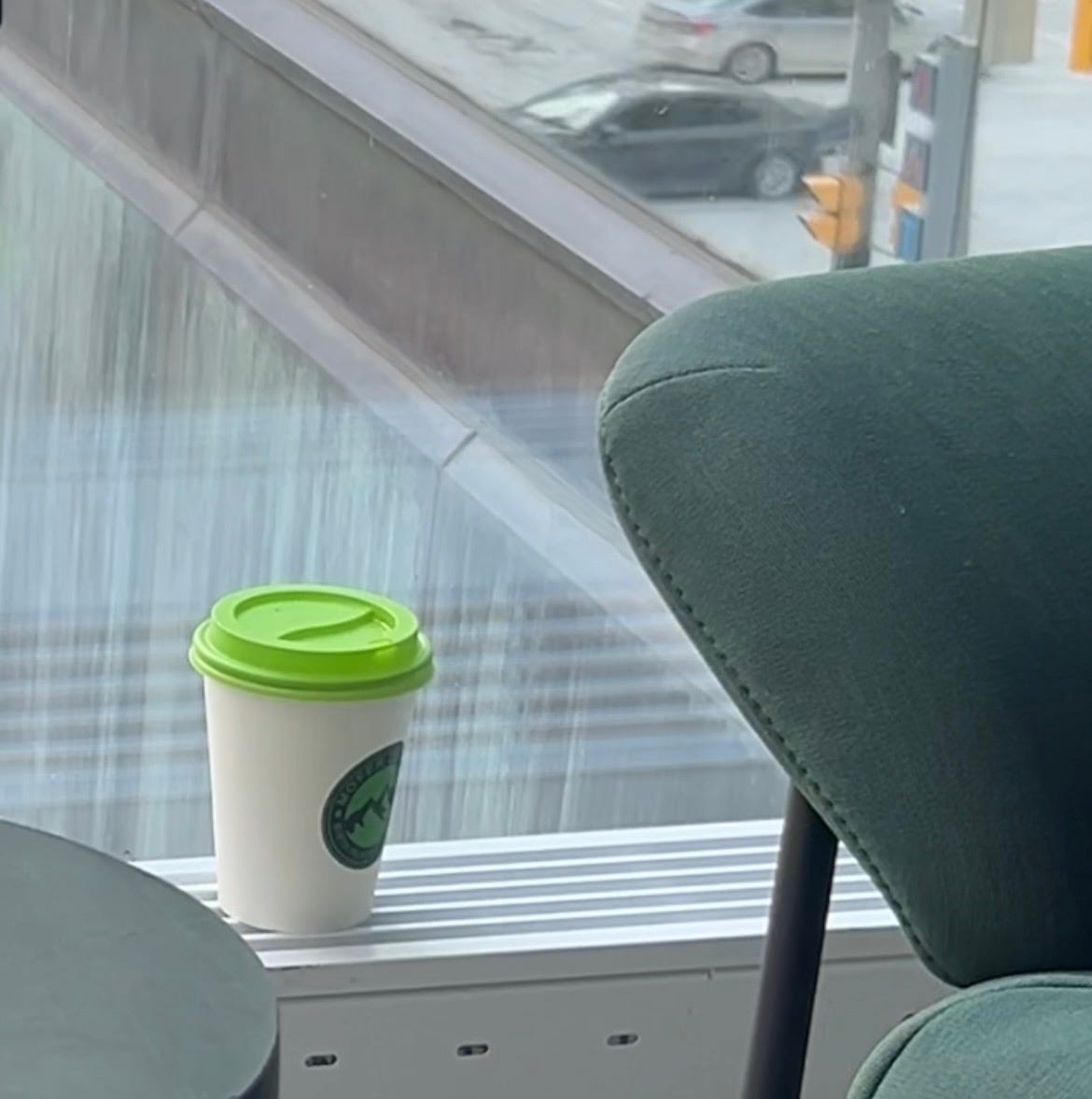
One cold DM and one cold walk to a Toronto WeWork later, I was sitting across from the man himself, Minjae.
The Man Behind the Message
Most of Minjae’s content is him going up to strangers, giving them a compliment or a quick well-wish.
It often begins with someone being shocked, silent, or taken aback, but it can end with a smile, a quick conversation, and a genuine “thank you”. You can read more about Minjae’s impact in his interview with CTV here.
When I cold DM’d Minjae to participate in 52 coffees, I had a slight concern in the back of my head: “Is this guy actually confident, or is this a facade?”
Any doubt was quickly squandered as soon as we met face to face. Minjae had an immediate warmth. In how he spoke, chatted, and toured me around the WeWork, I immediately knew there was no separation between who he was for the internet and who he was as a person.
I kicked off our conversation over coffee by asking Minjae if he’s always been able to talk to strangers with ease, and he said:
“I would say I got that gene from my grandpa. He was a really social guy and was really well-connected back in Korea. So I’ve always had that since I was a baby, and throughout elementary, high school, and university.”
Like many of us after leaving the structure of education, Minjae went down a winding road to find himself. He detailed his journey, including setbacks in the corporate world, attempts at various entrepreneurial ventures, overcoming personal challenges, and building confidence through self-improvement.
I was curious about Minjae’s ability to find the grit and resilience to keep picking himself back up after these setbacks. He said he knew he was a dreamer and a stable life didn’t attract him initially, but he soon realized that stability was a necessary precursor to a healthy mentality. He went on to describe a key turning point,
“It just started hitting me, because I started becoming self-aware of how it was affecting my family and how they view me, not just myself. I started realizing I was putting them through a lot of stress because they just want the best for me.”
When your decisions start affecting other people, it influences how you start showing up. For Minjae, this meant seriously nurturing what was beginning to grow: his social media following. He was diligent and consistent, and he chose to show up, even on days when he didn’t feel as confident as he exuded.
His ability to get back up and start again is ultimately what has led to some of his most viral content. As of today, he has amassed over 200k followers across platforms. These are huge metrics, but they are not what keep Minjae going; instead, he is driven to show up and share positivity in the Toronto community and beyond.
The Politeness Trap
We’ve normalized something strange: we’re all craving connection, but we’ve convinced ourselves that initiating it would be a burden.
Minjae’s content is a mirror for his own self-confidence, but is also a mirror for all of us. The content is straightforward: kind gestures to strangers. However, in our world where connection is fulfilled through our online communities, in-person serendipitous conversation is few and far between.
We may default to thinking it’s that damn phone, but really, I think it’s because we are scared to be a burden to other people. We assume silence equals politeness, that holding back shows respect for others’ boundaries.
Annaliese Todd calls this “the politeness trap” in her piece about the disappearing “small favour economy”:
“Our current social norms have created ‘the politeness trap.’ We’ve become so concerned with not imposing on others that we’ve actually made it harder to form meaningful connections. When we refuse to ask for help or offer it spontaneously, we’re inadvertently signalling that we don’t trust others to set their own boundaries. But here’s the thing: people generally want to help.”
Take 30 seconds to scroll through Minjae’s comment sections, and you’ll see what people are actually craving:
“I hope someone gives me this energy,”
“I wish I had the confidence to do this.”
People aren’t bothered by his acts; they’re actively craving a part of it in their lives, too.
Minjae’s sincerity is what makes it work. When I asked Minjae how he stays authentic while building a social media following, he said the data shows you which content performs well. It’s easy to lean into its patterns; however, whenever he tried to replicate what worked, whether consciously or subconsciously, it would fall flat. When the sincerity is gone, the message no longer resonates.
This matters because we’ve grown up in a world where vulnerability and community have been co-opted by corporations trying to market to us. That’s why some moments feel icky, why content feels weird, why we go into experiences expecting sincerity and leave feeling empty. We can sense when a connection is transactional.
Breaking these norms requires showing up without expectation. Small steps, such as offering a compliment, making eye contact, or initiating a brief chat, actively build trust and connection by rejecting the idea that conversation is a burden. These simple actions can serve as practical ways for readers to foster authenticity and community in their daily lives.
Pouring From a Full Cup
Putting yourself out on social media opens you up to being perceived by a massive audience, but in some ways, it can feel safer than putting yourself out there in front of strangers face-to-face.
I asked Minjae, “Have you learned more about being perceived from getting out of your comfort zone virtually or in person?”
His answer surprised me, as it wasn’t just one or the other, but the act of being perceived in both settings just taught him one thing: the importance of the relationship with himself.
When he first started posting content, and people reacted positively, they’d say things like “I love what you’re doing, I think it’s hilarious.” Minjae reflected that this reaction often gave him pause. From his perspective, he was just exuding confidence and charisma, not trying to be funny.
Through this journey of being perceived, he has learned to hold others’ perspectives without letting them define him. To stay true to himself and still show up authentically, regardless of how others might perceive it. They’re entitled to their own opinion, and that’s okay. For Minjae, this confidence was earned. He knows the work he put in to build his ability to show up and talk to strangers, to give without expecting return, and that is what he grounds his work in.
I asked Minjae for advice on how to improve confidence and begin this journey of giving back to the community, for both his audience and mine.
Surprisingly, his first recommendation was “take care of your health.” He noted that he can only show up authentically because he takes care of himself.
His recommendation made me think of the metaphor we often use about relationships and self-care: pouring from a full cup. To give without expecting anything in return, you need the energy, resources, and mental capacity to care for others without burning out. You cannot effectively support, love, or help others if you are physically or emotionally depleted yourself.
We see Minjae complimenting strangers on the TTC and think it’s just about confidence or extroversion. However, the foundation is much more practical: he has built a life that fills his cup, so he can pour out the excess to others who need it.
Maybe that’s where the rest of us need to start.
If we want to break the silence, to reject the politeness trap, to create the serendipitous connections we’re all craving, we first need to return to that small favour economy to fill ourselves up, so then we can continue to give.
Each day is an opportunity to put back out into the universe, and as Minjae has exemplified, these efforts compound over time.
As we finished our talk, Minjae said, “Good things take time, but great things can happen all at once,” and although he is in the moment of receiving the great, he doesn’t want to lose the mindset that brought him here.
Throughout this journey, he hopes to stay grounded, show up as himself, and continue the mission he started: giving to others without expecting anything in return.
Take some inspiration from Minjae this week. What can you do to share positivity with a stranger? Could you contribute to the small favour economy?
Introduce yourself to your neighbours?
We’re all human. We need connection. I sincerely believe that we miss each other. We miss the ease that connection once had before it was more “normal” to be silent.
So, make the first move this week. Not out of desire to get something in return, but rather out of deep care for another person that you wish to create some solidarity with.
Thank you so much to Minjae for taking a chance on a stranger and my project 52 Coffees! If you’re interested in getting involved, email me at bykstubbs@gmail.com :)
such a sweet idea!!
Come visit me in Montreal. Can't be lonely with meeee. Xo